What Is Wrong With People Who Can't Read
| Dyslexia | |
|---|---|
| Other names | Reading disorder, alexia |
 | |
| Dyslexic handwriting in Greek | |
| Specialty | Neurology, pediatrics |
| Symptoms | Problem reading[one] |
| Usual onset | School age[two] |
| Types | Surface dyslexia |
| Causes | Genetic and ecology factors[2] |
| Risk factors | Family history, attending deficit hyperactivity disorder[3] |
| Diagnostic method | Series memory, spelling, vision, and reading test[four] |
| Differential diagnosis | Hearing or vision problems, insufficient teaching[2] |
| Treatment | Adjusting didactics methods[1] |
| Frequency | 3–seven%[2] [5] |
Dyslexia, besides known as reading disorder, is a disorder characterized by reading below the expected level for their age.[1] [half dozen] Dissimilar people are affected to different degrees.[3] Issues may include difficulties in spelling words, reading chop-chop, writing words, "sounding out" words in the head, pronouncing words when reading aloud and understanding what one reads.[three] [7] Often these difficulties are first noticed at school.[ii] When someone who previously could read loses their ability, it is known as alexia.[3] The difficulties are involuntary and people with this disorder take a normal want to larn.[3] People with dyslexia have higher rates of attention deficit hyperactivity disorder (ADHD), developmental language disorders, and difficulties with numbers.[2] [8]
Dyslexia is believed to be acquired by the interaction of genetic and environmental factors.[two] Some cases run in families.[three] Dyslexia that develops due to a traumatic brain injury, stroke, or dementia is chosen "acquired dyslexia".[1] The underlying mechanisms of dyslexia result from differences inside the encephalon's language processing.[3] Dyslexia is diagnosed through a serial of tests of retention, vision, spelling, and reading skills.[4] Dyslexia is separate from reading difficulties acquired by hearing or vision problems or by insufficient teaching or opportunity to learn.[two]
Treatment involves adjusting didactics methods to meet the person'due south needs.[1] While not curing the underlying trouble, it may subtract the degree or impact of symptoms.[9] Treatments targeting vision are non effective.[10] Dyslexia is the about common learning disability and occurs in all areas of the world.[xi] It affects iii–vii% of the population;[2] [five] however, upwards to 20% of the full general population may take some degree of symptoms.[12] While dyslexia is more than often diagnosed in boys,[2] it has been suggested that it affects men and women equally.[11] Some believe that dyslexia should exist best considered as a dissimilar way of learning, with both benefits and downsides.[13] [14]
Classification
Dyslexia is divided into developmental and acquired forms. This commodity is primarily nearly developmental dyslexia, i.eastward., dyslexia that begins in early babyhood.[xv] Acquired dyslexia occurs subsequent to neurological insult, such as traumatic brain injury or stroke. People with caused dyslexia exhibit some of the signs or symptoms of the developmental disorder, merely requiring different cess strategies and treatment approaches.[sixteen] Pure alexia, also known as agnosic alexia or pure word blindness, is one class of alexia which makes up "the peripheral dyslexia" grouping.[17]
Signs and symptoms
In early babyhood, symptoms that correlate with a later diagnosis of dyslexia include delayed onset of speech and a lack of phonological sensation.[x] A common myth closely assembly dyslexia with mirror writing and reading letters or words backwards.[eighteen] These behaviors are seen in many children as they learn to read and write, and are non considered to be defining characteristics of dyslexia.[x]
School-age children with dyslexia may exhibit signs of difficulty in identifying or generating rhyming words, or counting the number of syllables in words–both of which depend on phonological sensation.[19] They may likewise testify difficulty in segmenting words into private sounds (such as sounding out the three sounds of 1000, a, and t in cat) or may struggle to blend sounds, indicating reduced phonemic sensation.[20]
Difficulties with word retrieval or naming things is also associated with dyslexia.[21] : 647 People with dyslexia are normally poor spellers, a feature sometimes called dysorthographia or dysgraphia, which depends on the skill of orthographic coding.[ten]
Problems persist into adolescence and machismo and may include difficulties with summarizing stories, memorization, reading aloud, or learning foreign languages. Adults with dyslexia tin often read with good comprehension, though they tend to read more slowly than others without a learning difficulty and perform worse in spelling tests or when reading nonsense words–a mensurate of phonological sensation.[22]
Associated conditions
Dyslexia oftentimes co-occurs with other learning disorders, just the reasons for this comorbidity take not been conspicuously identified.[23] These associated disabilities include:
- Dysgraphia
- A disorder involving difficulties with writing or typing, sometimes due to problems with middle–hand coordination; it also can impede direction- or sequence-oriented processes, such as tying knots or carrying out repetitive tasks.[24] In dyslexia, dysgraphia is ofttimes multifactorial, due to dumb letter-writing automaticity, organizational and elaborative difficulties, and impaired visual word forming, which makes it more hard to retrieve the visual picture of words required for spelling.[24]
- Attention deficit hyperactivity disorder (ADHD)
- A disorder characterized by bug sustaining attention, hyperactivity, or acting impulsively.[25] Dyslexia and ADHD commonly occur together.[5] [26] [27] Approximately xv%[10] or 12–24% of people with dyslexia accept ADHD;[28] and up to 35% of people with ADHD take dyslexia.[ten]
- Auditory processing disorder
- A listening disorder that affects the power to process auditory information.[29] [thirty] This can pb to problems with auditory memory and auditory sequencing. Many people with dyslexia accept auditory processing bug, and may develop their own logographic cues to recoup for this type of deficit. Some inquiry suggests that auditory processing skills could be the principal shortfall in dyslexia.[31] [32]
- Developmental coordination disorder
- A neurological condition characterized by difficulty in carrying out routine tasks involving balance, fine-motor control, kinesthetic coordination, difficulty in the use of oral communication sounds, bug with short-term memory, and organization.[33]
Causes
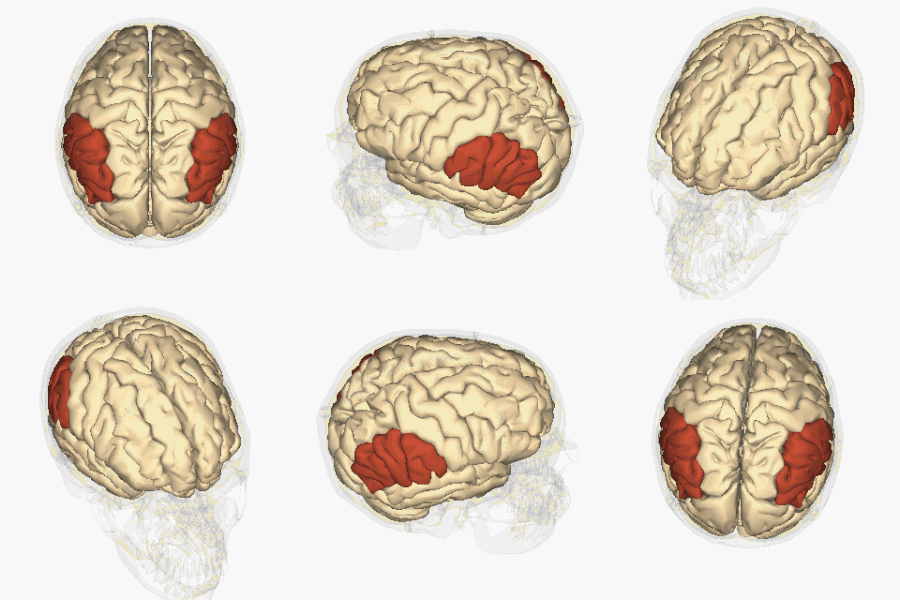
Junior parietal lobule – superior view animation
Researchers have been trying to find the neurobiological basis of dyslexia since the condition was get-go identified in 1881.[34] [35] For example, some have tried to associate the common problem amidst people with dyslexia of not being able to see letters clearly to aberrant evolution of their visual nervus cells.[36]
Neuroanatomy
Neuroimaging techniques, such as functional magnetic resonance imaging (fMRI) and positron emission tomography (PET), accept shown a correlation between both functional and structural differences in the brains of children with reading difficulties.[37] Some people with dyslexia show less electrical activation in parts of the left hemisphere of the encephalon involved with reading, such every bit the junior frontal gyrus, junior parietal lobule, and the centre and ventral temporal cortex.[31] Over the by decade, brain activation studies using PET to study language have produced a breakthrough in the understanding of the neural ground of language. Neural bases for the visual lexicon and for auditory verbal brusk-term memory components have been proposed,[38] with some implication that the observed neural manifestation of developmental dyslexia is job-specific (i.due east., functional rather than structural). fMRIs of people with dyslexia point an interactive role of the cerebellum and cerebral cortex as well every bit other brain structures in reading.[39] [40]
The cerebellar theory of dyslexia proposes that impairment of cerebellum-controlled muscle movement affects the formation of words past the natural language and facial muscles, resulting in the fluency bug that some people with dyslexia feel. The cerebellum is also involved in the automatization of some tasks, such as reading.[41] The fact that some children with dyslexia have motor task and balance impairments could be consistent with a cerebellar role in their reading difficulties. Notwithstanding, the cerebellar theory has not been supported by controlled research studies.[42]
Genetics
Enquiry into potential genetic causes of dyslexia has its roots in post-dissection examination of the brains of people with dyslexia.[36] Observed anatomical differences in the language centers of such brains include microscopic cortical malformations known equally ectopias, and more rarely, vascular micro-malformations, and microgyrus—a smaller than usual size for the gyrus.[43] The previously cited studies and others[44] suggest that abnormal cortical evolution, presumed to occur before or during the sixth month of fetal brain development, may have caused the abnormalities. Abnormal cell formations in people with dyslexia have also been reported in non-language cerebral and subcortical brain structures.[45] Several genes accept been associated with dyslexia, including DCDC2[46] and KIAA0319[47] on chromosome vi, and DYX1C1 on chromosome xv.[48]
Gene–environment interaction
The contribution of cistron–environment interaction to reading disability has been intensely studied using twin studies, which estimate the proportion of variance associated with a person's environment and the proportion associated with their genes. Both environmental and genetic factors announced to contribute to reading development. Studies examining the influence of environmental factors such as parental education[49] and teaching quality[fifty] accept determined that genetics take greater influence in supportive, rather than less optimal, environments.[51] However, more optimal atmospheric condition may merely let those genetic risk factors to account for more than of the variance in outcome because the environmental risk factors accept been minimized.[51]
As environs plays a large role in learning and memory, it is likely that epigenetic modifications play an important role in reading ability. Measures of cistron expression, histone modifications, and methylation in the human periphery are used to report epigenetic processes; however, all of these accept limitations in the extrapolation of results for awarding to the man brain.[52] [53]
Language
The orthographic complexity of a language directly affects how difficult it is to larn to read it.[54] : 266 English and French have comparatively "deep" phonemic orthographies within the Latin alphabet writing organisation, with complex structures employing spelling patterns on several levels: letter-audio correspondence, syllables, and morphemes.[55] : 421 Languages such as Spanish, Italian and Finnish primarily employ letter-sound correspondence—so-chosen "shallow" orthographies—which makes them easier to acquire for people with dyslexia.[54] : 266 Logographic writing systems, such as Chinese characters, take extensive symbol use; and these also pose problems for dyslexic learners.[56]
Pathophysiology
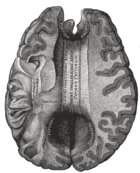
Corpus callosum view, front office at top of epitome
For most people who are right-paw dominant, the left hemisphere of their brain is more specialized for language processing. With regard to the machinery of dyslexia, fMRI studies propose that this specialization is less pronounced or absent in people with dyslexia. In other studies, dyslexia is correlated with anatomical differences in the corpus callosum, the bundle of nerve fibers that connects the left and right hemispheres.[57]
Data via diffusion tensor MRI bespeak changes in connectivity or in gray matter density in areas related to reading and language. Finally, the left inferior frontal gyrus has shown differences in phonological processing in people with dyslexia.[57] Neurophysiological and imaging procedures are being used to ascertain phenotypic characteristics in people with dyslexia, thus identifying the effects of dyslexia-related genes.[58]
Dual road theory
The dual-road theory of reading aloud was commencement described in the early 1970s.[59] This theory suggests that two split up mental mechanisms, or cognitive routes, are involved in reading aloud.[threescore] One mechanism is the lexical route, which is the process whereby skilled readers can recognize known words by sight alone, through a "dictionary" lookup procedure.[61] The other machinery is the nonlexical or sublexical route, which is the process whereby the reader can "sound out" a written give-and-take.[61] [62] This is done by identifying the word'due south constituent parts (letters, phonemes, graphemes) and applying knowledge of how these parts are associated with each other, for case, how a string of neighboring letters audio together.[59] The dual-route system could explain the different rates of dyslexia occurrence between unlike languages (e.g., the consistency of phonological rules in the Spanish language could business relationship for the fact that Castilian-speaking children show a college level of performance in non-word reading, when compared to English-speakers).[54] [63]
Diagnosis
Dyslexia is a heterogeneous, dimensional learning disorder that impairs accurate and fluent word reading and spelling.[64] [65] Typical—but non universal—features include difficulties with phonological awareness; inefficient and oft inaccurate processing of sounds in oral language (phonological processing); and verbal working memory deficits.[66] [67]
Dyslexia is a neurodevelopmental disorder, subcategorized in diagnostic guides as a learning disorder with harm in reading (ICD-11 prefixes "developmental" to "learning disorder"; DSM-5 uses "specific").[68] [69] [70] Dyslexia is non a trouble with intelligence. Emotional bug often arise secondary to learning difficulties.[71] The National Institute of Neurological Disorders and Stroke describes dyslexia as "difficulty with phonological processing (the manipulation of sounds), spelling, and/or rapid visual-verbal responding".[1]
The British Dyslexia Association defines dyslexia as "a learning difficulty that primarily affects the skills involved in accurate and fluent word reading and spelling" and is characterized past "difficulties in phonological awareness, verbal retention and verbal processing speed".[72] Phonological awareness enables one to identify, discriminate, remember (working memory), and mentally dispense the sound structures of language—phonemes, onsite-rime segments, syllables, and words.[73] [74]
Assessment
In assessing the individual for this disorder the following are several things that tin can be done.
A multidisciplinary team arroyo involving the kid'south parent(southward) and teacher(s), school psychologist, pediatrician, and, as appropriate, speech and language pathologist (speech therapist), and occupational therapist.[75]
Have familiarity with typical ages children reach various general developmental milestones, and domain-specific milestones, such as phonological awareness (recognize rhyming words; place the initial sounds in words).[76]
Tests should not be relied on exclusively. Careful ascertainment of the child in the school and home environments, and sensitive, comprehensive parental interviews are just as of import every bit tests.[77] [78]
Look at the empirically supported response to intervention (RTI) approach,[79] which "... involves monitoring the progress of a grouping of children through a plan of intervention rather than undertaking a static cess of their current skills. Children with the most need are those who neglect to respond to effective teaching, and they are readily identified using this approach."[80]
Cess tests
There is a broad range of tests that are used in clinical and educational settings to evaluate the possibility that a person might accept dyslexia.[81] If initial testing suggests that a person might accept dyslexia, such tests are often followed up with a full diagnostic assessment to determine the extent and nature of the disorder.[82] Some tests tin be administered by a teacher or calculator; others crave specialized training and are given by psychologists.[83] Some test results indicate how to carry out education strategies.[83] [84] Considering a diverseness of unlike cognitive, behavioral, emotional, and environmental factors all could contribute to difficultly learning to read, a comprehensive evaluation should consider these different possibilities. These tests and observations can include:[85]
- Full general measures of cognitive ability, such every bit the Wechsler Intelligence Scale for Children, Woodcock-Johnson Tests of Cerebral Abilities, or Stanford-Binet Intelligence Scales. Low general cerebral power would make reading more difficult. Cerebral ability measures besides oft effort to measure different cognitive processes, such as verbal ability, nonverbal and spatial reasoning, working memory, and processing speed. In that location are different versions of these tests for dissimilar age groups. About all of these require additional preparation to give and score correctly, and are done by psychologists. Co-ordinate to Mather and Schneider (2015), a confirmatory profile and/or design of scores on cerebral tests confirming or ruling-out reading disorder has not nevertheless been identified.[86]
- Screening or evaluation for mental health weather condition: Parents and teachers can complete rating scales or beliefs checklists to gather information about emotional and behavioral operation for younger people. Many checklists have like versions for parents, teachers, and younger people old enough to read reasonably well (ofttimes 11 years and older) to complete. Examples include the Behavioral Assessment Organization for Children, and the Strengths and Difficulties Questionnaire. All of these have nationally representative norms, making it possible to compare the level of symptoms to what would be typical for the younger person's age and biological sex. Other checklists link more specifically to psychiatric diagnoses, such as the Vanderbilt ADHD Rating Scales or the Screen for Child Feet Related Emotional Disorders (SCARED). Screening uses brief tools that are designed to catch cases with a disorder, but they often get false positive scores for people who do non take the disorder. Screeners should be followed up by a more accurate test or diagnostic interview as a result. Depressive disorders and anxiety disorders are two-three times higher in people with dyslexia, and attention-deficit/hyperactivity disorder is more common, likewise.[87] [88] [89] [90]
- Review of academic achievement and skills: Average spelling/reading ability for a dyslexic is a percent ranking <16, well below normal. In add-on to reviewing grades and teacher notes, standardized test results are helpful in evaluating progress. These include grouping administered tests, such as the Iowa Tests of Educational Development, that a teacher may give to a group or whole classroom of younger people at the same fourth dimension. They too could include individually administered tests of achievement, such as the Wide Range Achievement Examination, or the Woodcock-Johnson (which also includes a set of achievement tests). The individually administered tests again require more specialized training.[91] [92] [93]
Screening
Screening procedures seek to place children who show signs of possible dyslexia. In the preschool years, a family history of dyslexia, peculiarly in biological parents and siblings, predicts an eventual dyslexia diagnosis better than any test.[94] In principal school (ages 5–7), the ideal screening procedure consist of training master school teachers to carefully observe and record their pupils' progress through the phonics curriculum, and thereby identify children progressing slowly.[95] [96] When teachers identify such students they tin can supplement their observations with screening tests such as the Phonics screening check [97] used past Great britain schools during Year 1.
In the medical setting, child and boyish psychiatrist Thousand. S. Thambirajah emphasizes that "[yard]iven the loftier prevalence of developmental disorders in school-aged children, all children seen in clinics should be systematically screened for developmental disorders irrespective of the presenting problem/s." Thambirajah recommends screening for developmental disorders, including dyslexia, by conducting a brief developmental history, a preliminary psychosocial developmental examination, and obtaining a school written report regarding bookish and social functioning.[98]
Management
Through the use of compensation strategies, therapy and educational back up, individuals with dyslexia can learn to read and write.[99] There are techniques and technical aids that aid to manage or conceal symptoms of the disorder.[100] Reducing stress and anxiety tin sometimes improve written comprehension.[101] For dyslexia intervention with alphabet-writing systems, the fundamental aim is to increase a child's sensation of correspondences between graphemes (messages) and phonemes (sounds), and to relate these to reading and spelling by teaching how sounds blend into words. Reinforced collateral training focused on reading and spelling may yield longer-lasting gains than oral phonological preparation alone.[102] Early intervention tin can be successful in reducing reading failure.[103]
Inquiry does not suggest that peculiarly-tailored fonts (such as Dyslexie and OpenDyslexic) help with reading.[104] Children with dyslexia read text set in a regular font such as Times New Roman and Arial just as quickly, and they show a preference for regular fonts over peculiarly-tailored fonts.[104] Some research has pointed to increased letter-spacing being beneficial.[104]
There is currently no show showing that music educational activity significantly improves the reading skills of adolescents with dyslexia.[105]
Prognosis
Dyslexic children require special instruction for word analysis and spelling from an early age.[106] The prognosis, mostly speaking, is positive for individuals who are identified in babyhood and receive support from friends and family.[1] The New York educational system (NYED) indicates "a daily uninterrupted xc-minute block of educational activity in reading", furthermore "educational activity in phonemic sensation, phonics, vocabulary evolution, reading fluency" so as to improve the private's reading ability.[107]
Epidemiology
The percentage of people with dyslexia is unknown, merely it has been estimated to be as low every bit five% and every bit loftier every bit 17% of the population.[108] While it is diagnosed more frequently in males,[2] some believe that it affects males and females every bit.
There are different definitions of dyslexia used throughout the world, only despite significant differences in writing systems, dyslexia occurs in different populations.[109] Dyslexia is non limited to difficulty in converting letters to sounds, and Chinese people with dyslexia may have difficulty converting Chinese characters into their meanings.[110] [111] The Chinese vocabulary uses logographic, monographic, non-alphabet writing where one graphic symbol can stand for an private phoneme.[112]
The phonological-processing hypothesis attempts to explain why dyslexia occurs in a wide variety of languages. Furthermore, the relationship between phonological capacity and reading appears to be influenced by orthography.[113]
History
Dyslexia was clinically described past Oswald Berkhan in 1881,[34] merely the term dyslexia was coined in 1883 by Rudolf Berlin, an ophthalmologist in Stuttgart.[114] [115] [116] He used the term to refer to the case of a young boy who had astringent difficulty learning to read and write, despite showing typical intelligence and physical abilities in all other respects.[117] In 1896, W. Pringle Morgan, a British physician from Seaford, E Sussex, published a description of a reading-specific learning disorder in a report to the British Medical Journal titled "Congenital Discussion Blindness".[118] The distinction between phonological versus surface types of dyslexia is only descriptive, and without any etiological assumption equally to the underlying brain mechanisms. However, studies have alluded to potential differences due to variation in operation.[119] Over fourth dimension, we accept changed from the intelligence-based model to the age-based model, in terms of those with Dyslexia.[120] [84]
Lodge and culture
Every bit is the case with any disorder, society oft makes an assessment based on incomplete information. Earlier the 1980s, dyslexia was thought to be a consequence of education, rather than a neurological disability. Every bit a outcome, guild often misjudges those with the disorder.[101] There is also sometimes a workplace stigma and negative attitude towards those with dyslexia.[121] If the instructors of a person with dyslexia lack the necessary training to support a child with the condition, at that place is often a negative effect on the student's learning participation.[122]
Since at to the lowest degree the 1960s in the Great britain, the children diagnosed with developmental dyslexia have consistently been from privileged families.[123] Although half of prisoners in the Uk accept significant reading difficulties, very few take ever been evaluated for dyslexia.[123] Admission to some special educational resources and funding is contingent upon having a diagnosis of dyslexia.[123] Equally a issue, when Staffordshire and Warwickshire proposed in 2018 to teach reading to all children with reading difficulties, using techniques proven to be successful for about children with a diagnosis of dyslexia, without first requiring the families to obtain an official diagnosis, dyslexia advocates and parents of children with dyslexia were fearful that they were losing a privileged status.[123]
Inquiry

Near dyslexia enquiry relates to alphabetic writing systems, and especially to European languages.[124] Still, substantial research is also available regarding people with dyslexia who speak Arabic, Chinese, Hebrew, or other languages.[125] The outward expression of individuals, with reading disability and regular poor readers is the same in some respects.[126]
See too
- Dyscalculia, difficulty comprehending numbers and math
- Learning to read
- Orton-Gillingham
References
- ^ a b c d e f g "Dyslexia Information Page". National Plant of Neurological Disorders and Stroke. 2 Nov 2018.
- ^ a b c d e f g h i j k Peterson, Robin L.; Pennington, Bruce F. (May 2012). "Developmental dyslexia". Lancet. 379 (9830): 1997–2007. doi:10.1016/S0140-6736(12)60198-6. PMC3465717. PMID 22513218.
- ^ a b c d e f g "What are reading disorders?". National Institutes of Health. i December 2016.
- ^ a b "How are reading disorders diagnosed?". National Institutes of Health. Archived from the original on 2 April 2015. Retrieved 15 March 2015.
- ^ a b c Kooij, J. J. Sandra (2013). Adult ADHD diagnostic assessment and treatment (tertiary ed.). London: Springer. p. 83. ISBN9781447141389. Archived from the original on 30 April 2016.
- ^ Siegel LS (Nov 2006). "Perspectives on dyslexia". Paediatrics & Kid Health. 11 (ix): 581–seven. doi:10.1093/pch/11.9.581. PMC2528651. PMID 19030329.
- ^ "What are the symptoms of reading disorders?". National Institutes of Wellness. 1 December 2016.
- ^ Sexton, Chris C.; Gelhorn, Heather L.; Bell, Jill A.; Classi, Peter Thou. (November 2012). "The Co-occurrence of Reading Disorder and ADHD: Epidemiology, Treatment, Psychosocial Impact, and Economical Burden". Journal of Learning Disabilities. 45 (6): 538–564. doi:x.1177/0022219411407772. PMID 21757683. S2CID 385238.
- ^ "What are common treatments for reading disorders?". National Institutes of Wellness. Archived from the original on 2 April 2015. Retrieved 15 March 2015.
- ^ a b c d e f Handler, SM; Fierson, WM; Section on, Ophthalmology; Council on Children with, Disabilities; American Academy of, Ophthalmology; American Association for Pediatric Ophthalmology and, Strabismus; American Association of Certified, Orthoptists (March 2011). "Learning disabilities, dyslexia, and vision". Pediatrics. 127 (3): e818–56. doi:10.1542/peds.2010-3670. PMID 21357342.
- ^ a b Umphred, Darcy Ann; Lazaro, Rolando T.; Roller, Margaret; Burton, Gordon (2013). Neurological Rehabilitation. Elsevier Health Sciences. p. 383. ISBN978-0-323-26649-ix. Archived from the original on 9 January 2017.
- ^ "How many people are affected past/at risk for reading disorders?". National Institutes of Wellness. Archived from the original on 2 Apr 2015. Retrieved 15 March 2015.
- ^ Venton, Danielle (September 2011). "The Unappreciated Benefits of Dyslexia". Wired. Archived from the original on 5 Baronial 2016. Retrieved x August 2016.
- ^ Mathew, Schneps (Baronial 2014). "The Advantages of Dyslexia". ScientificAmerican.com. Scientific American. Archived from the original on four August 2016. Retrieved 10 August 2016.
- ^ Oxford English Dictionary. tertiary ed. "dyslexia, north. Oxford, UK: Oxford University Press, 2012 ("a learning disability specifically affecting the attainment of literacy, with difficulty esp. in give-and-take recognition, spelling, and the conversion of letters to sounds, occurring in a child with otherwise normal development, and now usually regarded as a neurodevelopmental disorder with a genetic component.")
- ^ Woollams, Anna M. (19 January 2014). "Connectionist neuropsychology: uncovering ultimate causes of acquired dyslexia". Philosophical Transactions of the Royal Society B: Biological Sciences. 369 (1634): 20120398. doi:10.1098/rstb.2012.0398. ISSN 0962-8436. PMC3866427. PMID 24324241.
- ^ Coslett HB (2000). "Acquired dyslexia". Semin Neurol. twenty (4): 419–26. doi:10.1055/s-2000-13174. PMID 11149697.
- ^ Lilienfeld, Scott O.; Lynn, Steven Jay; Ruscio, John; Beyerstein, Barry L. (15 September 2011). l Keen Myths of Pop Psychology: Shattering Widespread Misconceptions nigh Man Behavior. John Wiley & Sons. pp. 88–89. ISBN978-1-4443-6074-5. Archived from the original on 9 January 2017. Retrieved 19 May 2016.
- ^ "Dyslexia and Related Disorders" (PDF). Alabama Dyslexia Clan. International Dyslexia Clan. Jan 2003. Archived (PDF) from the original on 4 March 2016. Retrieved 29 April 2015.
- ^ Peer, Lindsay; Reid, Gavin (2014). Multilingualism, Literacy and Dyslexia. Routledge. p. 219. ISBN978-i-136-60899-5. Archived from the original on nine January 2017.
- ^ Shaywitz, Emerge E.; Shaywitz, Bennett A. (2013). "Affiliate 34 Making a Hidden Disability Visible: What Has Been Learned from Neurobiological Studies of Dyslexia". In Swanson, H. Lee; Harris, Karen R.; Graham, Steve (eds.). Handbook of Learning Disabilities (ii ed.). Guilford Printing. ISBN978-i-4625-0856-3. Archived from the original on 9 January 2017.
- ^ Jarrad, Lum (October 2013). "Procedural learning is dumb in dyslexia: evidence from a meta-analysis of serial reaction fourth dimension studies". Research in Developmental Disabilities. 34 (10): 3460–76. doi:10.1016/j.ridd.2013.07.017. PMC3784964. PMID 23920029.
- ^ Nicolson, R. I.; Fawcett, A. J. (September 2009). "Dyslexia, dysgraphia, procedural learning and the cerebellum". Cortex. 47 (1): 117–27. doi:10.1016/j.cortex.2009.08.016. PMID 19818437. S2CID 32228208.
- ^ a b Reynolds, Cecil R.; Fletcher-Janzen, Elaine (2 January 2007). Encyclopedia of Special Educational activity. John Wiley & Sons. p. 771. ISBN978-0-471-67798-7.
- ^ "Attention Deficit Hyperactivity Disorder". NIH: National Institute of Mental Health. March 2016. Archived from the original on 23 July 2016. Retrieved 26 July 2016.
- ^ Comer, Ronald (2011). Psychology Around Us. RR Donnelley. p. one. ISBN978-0-471-38519-6. Archived from the original on 4 June 2016.
- ^ Germanò, E; Gagliano, A; Curatolo, P (2010). "Comorbidity of ADHD and Dyslexia" (PDF). Developmental Neuropsychology. 35 (5): 475–493. doi:10.1080/87565641.2010.494748. PMID 20721770. S2CID 42046958.
- ^ Fatemi, South. Hossein; Sartorius, Norman; Clayton, Paula J. (2008). The Medical Basis of Psychiatry (iii ed.). Springer Scientific discipline & Business Media. p. 308. ISBN978-1-59745-252-half dozen. Archived from the original on 9 January 2017.
- ^ Capellini, Simone Aparecida (2007). Neuropsycholinguistic Perspectives on Dyslexia and Other Learning Disabilities. Nova Publishers. p. 94. ISBN978-one-60021-537-7. Archived from the original on nine Jan 2017.
- ^ Moore, D. R. (July 2011). "The diagnosis and management of auditory processing disorder". Linguistic communication, Speech, and Hearing Services in Schools. 42 (3): 303–viii. doi:ten.1044/0161-1461(2011/10-0032). PMID 21757566.
- ^ a b Pammer, Kristen (Jan 2014). "Encephalon mechanisms and reading remediation: more questions than answers". Scientifica. 2014: 802741. doi:10.1155/2014/802741. PMC3913493. PMID 24527259.
- ^ Constabulary, J (2014). "relationship of phonological power, spoken communication perception, and auditory perception in adults with dyslexia". Frontiers in Man Neuroscience. 8: 482. doi:10.3389/fnhum.2014.00482. PMC4078926. PMID 25071512.
- ^ Susan J. Pickering (2012). "Affiliate 2. Working Memory in Dyslexia". In Alloway, Tracy Packiam; Gathercole, Susan E. (eds.). Working Retentivity and Neurodevelopmental Disorders. Psychology Printing. ISBN978-1-135-42134-2. Archived from the original on ix January 2017.
- ^ a b Berkhan O (1917). "Über die Wortblindheit, ein Stammeln im Sprechen und Schreiben, ein Fehl im Lesen" [About word blindness, adyslalia of speech and writing, a weakness in reading]. Neurologisches Centralblatt (in German). 36: 914–27.
- ^ Reid, Gavin; Fawcett, Angela; Manis, Frank; Siegel, Linda (2008). The SAGE Handbook of Dyslexia. SAGE Publications. p. 127. ISBN978-ane-84860-037-9. Archived from the original on 9 January 2017.
- ^ a b Stein, John (2014). "Dyslexia: the Function of Vision and Visual Attention". Current Developmental Disorders Reports. one (4): 267–fourscore. doi:ten.1007/s40474-014-0030-6. PMC4203994. PMID 25346883.
- ^ Whitaker, Harry A. (2010). Concise Encyclopedia of Brain and Language. Elsevier. p. 180. ISBN978-0-08-096499-7. Archived from the original on 9 January 2017.
- ^ Price, cathy (16 August 2012). "A Review and Synthesis of the first 20 years of Pet and fMRI studies of heard Speech, Spoken Language and Reading". NeuroImage. 62 (2): 816–847. doi:10.1016/j.neuroimage.2012.04.062. PMC3398395. PMID 22584224.
- ^ Sharifi, South (May 2014). "Neuroimaging essentials in essential tremor: a systematic review". NeuroImage: Clinical. 5: 217–231. doi:10.1016/j.nicl.2014.05.003. PMC4110352. PMID 25068111.
- ^ Brandler, William (Feb 2014). "The genetic relationship between handedness and neurodevelopmental disorders". Trends in Molecular Medicine. xx (2): 83–90. doi:x.1016/j.molmed.2013.10.008. PMC3969300. PMID 24275328.
- ^ Cain, Kate (2010). Reading development and difficulties (1st ed.). TJ International. p. 134. ISBN9781405151559 . Retrieved 21 March 2015.
- ^ Levav, Itzhak (2009). Psychiatric and Behavioral Disorders in State of israel: From Epidemiology to Mental wellness. Green Publishing. p. 52. ISBN9789652294685 . Retrieved 21 March 2015.
- ^ Faust, Miriam (2012). The Handbook of the Neuropsychology of Language. John Wiley & Sons. pp. 941–43. ISBN978-1-4443-3040-three. Archived from the original on 9 January 2017.
- ^ Benitez, A (Nov 2010). "Neurobiology and neurogenetics of dyslexia". Neurology (In Spanish). 25 (9): 563–81. doi:ten.1016/j.nrl.2009.12.010. PMID 21093706.
- ^ Kere, Julia (September 2014). "The molecular genetics and neurobiology of developmental dyslexia as model of a circuitous phenotype". Biochemical and Biophysical Research Communications. 452 (two): 236–43. doi:10.1016/j.bbrc.2014.07.102. PMID 25078623.
- ^ Marshall, Chloë R. (2012). Current Issues in Developmental Disorders. Psychology Printing. pp. 53–56. ISBN978-1-136-23067-7. Archived from the original on 9 January 2017.
- ^ Paracchini S, Thomas A, Castro S, Lai C, Paramasivam Thou, Wang Y, Keating B J, Taylor J Thou, Hacking D F, Scerri T, Francks C, Richardson A J, Wade-Martins R, Stein J F, Knight J C, Copp A J, LoTurco J, Monaco A P (15 May 2006). "The chromosome 6p22 haplotype associated with dyslexia reduces the expression of KIAA0319, a novel gene involved in neuronal migration". Human being Molecular Genetics. 15 (10): 1659–1666. doi:10.1093/hmg/ddl089. PMID 16600991.
{{cite journal}}: CS1 maint: uses authors parameter (link) - ^ Rosen, Glenn D. (2013). The Dyslexic Encephalon: New Pathways in Neuroscience Discovery. Psychology Printing. p. 342. ISBN978-1-134-81550-0. Archived from the original on 9 Jan 2017.
- ^ Friend, A; Defries, J. C.; Olson, R. K. (November 2008). "Parental Didactics Moderates Genetic Influences on Reading Disability". Psychol. Sci. nineteen (11): 1124–30. doi:10.1111/j.1467-9280.2008.02213.x. PMC2605635. PMID 19076484.
- ^ Taylor, J.; Roehrig, A. D.; Hensler, B. Soden; Connor, C. Yard.; Schatschneider, C. (2010). "Teacher Quality Moderates the Genetic Effects on Early Reading". Science. 328 (5977): 512–4. Bibcode:2010Sci...328..512T. doi:10.1126/scientific discipline.1186149. PMC2905841. PMID 20413504.
- ^ a b Pennington, Bruce F.; McGrath, Lauren M.; Rosenberg, Jenni; Barnard, Holly; Smith, Shelley D.; Willcutt, Erik G.; Friend, Angela; Defries, John C.; Olson, Richard Thou. (January 2009). "Gene × Environment Interactions in Reading Disability and Attention-Arrears/Hyperactivity Disorder". Developmental Psychology. 45 (1): 77–89. doi:10.1037/a0014549. PMC2743891. PMID 19209992.
- ^ Roth, Tania L.; Roth, Eric D.; Sweatt, J. David (September 2010). "Epigenetic regulation of genes in learning and memory". Essays in Biochemistry. 48 (one): 263–74. doi:10.1042/bse0480263. PMID 20822498. S2CID 23229766.
- ^ Smith, Shelley D. (December 2011). "Arroyo to epigenetic analysis in linguistic communication disorders". Journal of Neurodevelopmental Disorders. 3 (4): 356–364. doi:10.1007/s11689-011-9099-y. ISSN 1866-1947. PMC3261263. PMID 22113455.
- ^ a b c Paulesu, Eraldo; Brunswick, Nicola and Paganelli, Federica (2010). "Cross-cultural differences in unimpaired and dyslexic reading: Behavioral and functional anatomical observations in readers of regular and irregular orthographies. Affiliate 12 in Reading and Dyslexia in Dissimilar Orthographies Archived ix Jan 2017 at the Wayback Machine. Eds. Nicola Brunswick, Siné McDougall, and Paul de Mornay Davies. Psychology Press. ISBN 9781135167813
- ^ Juel, Connie (2013). "The Touch on of Early School Experiences on Initial Reading". In David Chiliad. Dickinson; Susan B. Neuman (eds.). Handbook of Early Literacy Inquiry. Guilford Publications. ISBN978-1-4625-1470-0. Archived from the original on 9 January 2017.
- ^ Snowling, Margaret J; Hulme, Charles (i May 2012). "Annual Research Review: The nature and classification of reading disorders – a commentary on proposals for DSM-v". Journal of Child Psychology and Psychiatry, and Allied Disciplines. 53 (5): 593–607. doi:10.1111/j.1469-7610.2011.02495.x. PMC3492851. PMID 22141434.
- ^ a b Habib, Michael (2013). "Dyslexia". Pediatric Neurology Part I. Handbook of Clinical Neurology. Vol. 111. pp. 229–235. doi:ten.1016/B978-0-444-52891-9.00023-iii. ISBN9780444528919. PMID 23622168. Retrieved xix December 2018.
- ^ Schumacher, Johannes; Hoffmann, Per; Schmäl, Christine; Schulte‐Körne, Gerd; Nöthen, Markus Thou (2007). "Genetics of dyslexia: the evolving landscape". Journal of Medical Genetics. 44 (five): 289–297. doi:10.1136/jmg.2006.046516. PMC2597981. PMID 17307837.
- ^ a b Pritchard SC, Coltheart Thousand, Palethorpe S, Castles A; Coltheart; Palethorpe; Castles (Oct 2012). "Nonword reading: comparing dual-route cascaded and connectionist dual-process models with man data". J Exp Psychol Hum Percept Perform. 38 (5): 1268–88. doi:10.1037/a0026703. PMID 22309087.
{{cite journal}}: CS1 maint: multiple names: authors listing (link) - ^ Eysenck, Michael; Keane, Marking T. (2013). Cognitive Psychology 6e. Psychology Press. p. 373. ISBN978-1-134-44046-7. Archived from the original on ix Jan 2017.
- ^ a b Eysenck, Michael; Keane, Mark T. (2013). Cerebral Psychology 6e. Psychology Press. p. 450. ISBN978-1-134-44046-7. Archived from the original on nine January 2017.
- ^ Hulme, Charles; Joshi, R. Malatesha; Snowling, Margaret J. (2012). Reading and Spelling: Development and Disorders. Routledge. p. 151. ISBN978-ane-136-49807-7. Archived from the original on 9 January 2017.
- ^ Sprenger-Charolles, Liliane (2011). "Prevalence and Reliability of Phonological, Surface, and Mixed Profiles in Dyslexia: A Review of Studies Conducted in Languages Varying in Orthographic Depth". Scientific Studies of Reading. fifteen (6): 498–521. doi:ten.1080/10888438.2010.524463. S2CID 15227374. Archived from the original on 30 August 2017.
- ^ Boada, Richard; Willcutt, Erik Grand.; Pennington, Bruce F. (2012). "Agreement the Comorbidity Between Dyslexia and Attention-Deficit/Hyperactivity Disorder". Topics in Language Disorders. 32 (3): 270. doi:x.1097/tld.0b013e31826203ac. S2CID 43200465.
... Pennington proposed a multiple arrears model for circuitous disorders like dyslexia, hypothesizing that such complex disorders are heterogeneous conditions that ascend from the additive and interactive furnishings of multiple genetic and environmental risk factors, which then lead to weaknesses in multiple cognitive domains.
- ^ Pennington, B (September 2006). "From unmarried to multiple arrears models of developmental disorders". Cognition. 101 (2): 385–413. doi:10.1016/j.cognition.2006.04.008. PMID 16844106. S2CID 7433822.
- ^ Peterson, Robin L.; Pennington, Bruce F. (28 March 2015). "Developmental Dyslexia". Annual Review of Clinical Psychology. 11 (1): 283–307. doi:ten.1146/annurev-clinpsy-032814-112842. PMID 25594880. SSRN 2588407.
- ^ Snowling, Margaret J. Dyslexia: A Very Brusk Introduction. Oxford University Printing, 2019. ISBN 9780192550422
- ^ "6A03.0 Developmental learning disorder with impairment in reading". International Classification of Diseases and Related Health Problems, 11th rev. (ICD-11) (Mortality and Morbidity Statistics). World Wellness Organisation. Retrieved 7 October 2019.
- ^ Diagnostic and statistical transmission of mental disorders : DSM-v . DSM-5 Task Strength. (fifth ed.). Arlington, VA: American Psychiatric Clan. 2013. ISBN9780890425541. OCLC 830807378.
Specific Learning Disorder with impairment in reading ... Dyslexia is an alternative term used to refer to a blueprint of learning difficulties characterized past issues with accurate or fluent word recognition, poor decoding, and poor spelling abilities.
{{cite book}}: CS1 maint: others (link) - ^ FragaGonzález, Gorka; Karipidis, Iliana; Tijms, Jurgen (19 October 2018). "Dyslexia as a Neurodevelopmental Disorder and What Makes It Different from a Chess Disorder". Brain Sciences. 8 (x): 189. doi:ten.3390/brainsci8100189. ISSN 2076-3425. PMC6209961. PMID 30347764.
- ^ Campbell, Robert Jean (2009). Campbell's Psychiatric Dictionary. Oxford University Press. pp. 310–312. ISBN978-0-19-534159-ane. Archived from the original on 9 January 2017.
- ^ Phillips, Sylvia; Kelly, Kathleen; Symes, Liz (2013). Assessment of Learners with Dyslexic-Type Difficulties. SAGE. p. 7. ISBN978-1-4462-8704-0. Archived from the original on 9 January 2017.
- ^ Stahl, Steven A.; Murray, Bruce A. (1994). "Defining phonological awareness and its human relationship to early on reading". Periodical of Educational Psychology. 86 (2): 221–234. doi:10.1037/0022-0663.86.2.221.
- ^ Rvachew, Susan; Ohberg, Alyssa; Grawburg, Meghann; Heyding, Joan (1 Nov 2003). "Phonological Awareness and Phonemic Perception in 4-Yr-Onetime Children With Delayed Expressive Phonology Skills". American Journal of Spoken language-Language Pathology. 12 (4): 463–471. doi:x.1044/1058-0360(2003/092). PMID 14658998. S2CID 16983189.
- ^ Catherine Christo, John M. Davis, and Stephen E. Brock, Identifying, Assessing, and Treating Dyslexia at School (New York: Springer Science+Business Media, 2009), 59.
- ^ Mather, Nancy and Barbara J. Wendling. Essentials of Dyslexia Assessment and Intervention. Hoboken, NJ: John Wiley & Sons, 2012.
- ^ Reid, Gavin and Jennie Guise. The Dyslexia Assessment. London: Bloomsbury, 2017 ("... assessment for dyslexia includes more than than tests; it involves comprehensive insights into the student's learning. This requires a full and comprehensive individual cess as well as consideration of the environment and contextual factors.").
- ^ Chiliad. Due south. Thambirajah, Developmental Cess of the Schoolhouse-Aged Child with Developmental Disabilities: A Clinician'south Guide (London: Jessica Kingsley, 2011), 74.
- ^ Jimerson, Shane R., Matthew Grand. Burns, and Amanda Chiliad. VanDerHeyden. Handbook of Response to Intervention: The Science and Exercise of Multi-Tiered Systems of Support. 2d ed. New York: Springer Science+Business organisation Media, 2016.
- ^ Snowling Margaret J (2013). "Early Identification and Interventions for Dyslexia: A Gimmicky View". Journal of Inquiry in Special Educational Needs. 13 (one): 7–14. doi:10.1111/j.1471-3802.2012.01262.ten. PMC4538781. PMID 26290655.
- ^ "Tests for Dyslexia and Learning Disabilities". University of Michigan. Archived from the original on xiii March 2015. Retrieved 15 March 2015.
- ^ Peer, Lindsay; Reid, Gavin (2013). Introduction to Dyslexia. Taylor & Francis. pp. 35–xl. ISBN978-1-135-37290-3. Archived from the original on ix January 2017.
- ^ a b "Screening and assessment". British Dyslexia Association. Archived from the original on 30 March 2015. Retrieved xi March 2015.
- ^ a b FLETCHER, JACK M. (2009). "Dyslexia: The development of a scientific concept". Periodical of the International Neuropsychological Society : JINS. 15 (four): 501–508. doi:10.1017/S1355617709090900. ISSN 1355-6177. Retrieved 1 March 2022.
- ^ Schulte-Körne, Gerd (October 2010). "The Prevention, Diagnosis, and Handling of Dyslexia". Deutsches Ärzteblatt International. 107 (41): 718–727. doi:x.3238/arztebl.2010.0718. ISSN 1866-0452. PMC2967798. PMID 21046003.
- ^ Mather, North., & Schneider, D. The use of intelligence tests in the diagnosis of specific reading disability.Goldstein, Sam; Princiotta, Dana; Naglieri, Jack A. (2014). Handbook of Intelligence: Evolutionary Theory, Historical Perspective, and Current Concepts. Springer. pp. 415–434. ISBN9781493915620 . Retrieved 10 January 2019.
- ^ Collett, Brent R.; Ohan, Jeneva L.; Myers, Kathleen M. (1 September 2003). "10-Year Review of Rating Scales. 5: Scales Assessing Attention-Deficit/Hyperactivity Disorder". Journal of the American Academy of Child & Boyish Psychiatry. 42 (nine): 1015–1037. doi:10.1097/01.CHI.0000070245.24125.B6. ISSN 0890-8567. PMID 12960702. Retrieved 3 October 2019.
- ^ Stone, Lisanne Fifty; Janssens, Jan K A M; Vermulst, Ad A; Van Der Maten, Marloes; Engels, Rutger C M E; Otten, Roy (20 Feb 2015). "The Strengths and Difficulties Questionnaire: psychometric properties of the parent and teacher version in children aged 4–7". BMC Psychology. 3 (1): iv. doi:10.1186/s40359-015-0061-eight. ISSN 2050-7283. PMC4364334. PMID 25815194.
- ^ Swart, K. T. (2005). "The Clinician's Guide to the Beliefs Assessment System For Children". The Canadian Child and Adolescent Psychiatry Review. fourteen (3): ninety. ISSN 1716-9119. PMC2542918.
- ^ Birmaher, B.; Khetarpal, South.; Brent, D.; Cully, Chiliad.; Balach, L.; Kaufman, J.; Neer, S. M. (1997). "The Screen for Kid Feet Related Emotional Disorders (SCARED): scale construction and psychometric characteristics". Journal of the American Academy of Kid and Adolescent Psychiatry. 36 (iv): 545–553. doi:x.1097/00004583-199704000-00018. ISSN 0890-8567. PMID 9100430.
- ^ Lindquist, E. F. (1953). The Iowa tests of educational evolution: how to use the test results; a transmission for teachers and counselors. Science Research Assembly. Retrieved 3 October 2019.
- ^ Dell, Cindy Ann; Harrold, Barbara; Dell, Thomas (1 Oct 2008). "Exam Review: Wilkinson, G. South., & Robertson, Yard. J. (2006). Wide Range Achievement Exam—Fourth Edition. Lutz, FL: Psychological Cess Resources. WRAT4 Introductory Kit (includes transmission, 25 test/response forms [blue and light-green], and accompanying examination materials): $243.00". Rehabilitation Counseling Bulletin. 52 (1): 57–threescore. doi:10.1177/0034355208320076. ISSN 0034-3552. S2CID 145644409.
- ^ Semrud-Clikeman, Margaret; Ellison, Phyllis Anne Teeter (2009). Child Neuropsychology: Cess and Interventions for Neurodevelopmental Disorders, 2nd Edition. Springer Science & Business Media. p. 119. ISBN9780387889634 . Retrieved 3 October 2019.
- ^ Catherine Christo, John Chiliad. Davis, and Stephen E. Brock, Identifying, Assessing, and Treating Dyslexia at Schoolhouse (New York: Springer Science+Business Media, 2009), 56. ISBN 9780387885995
- ^ Margaret J. Snowling, Dyslexia: A Very Brusk Introduction (Oxford, UK: Oxford University Press, 2019), 93–94.
- ^ Messages and Sounds: Principles and Practice of High Quality Phonics, Ref: DFES-00281-2007 (00281-2007BKT-EN), Principal National Strategy, Section for Education and Skills (United Kingdom), 2007.
- ^ "Phonics screening check: 2019 materials". United kingdom Department for Pedagogy, Standards and Testing Agency . Retrieved 14 Oct 2019.
- ^ Thambirajah, 1000. S. (2011). Developmental assessment of the school-aged kid with developmental disabilities : a clinician's guide. London: Jessica Kingsley Publishers. ISBN9780857003256. OCLC 747410566.
- ^ Bogon, Johana (Oct 2014). "TVA based cess of visual attention functions in developmental dyslexia". Frontiers in Psychology. 5: 1172. doi:10.3389/fpsyg.2014.01172. PMC4199262. PMID 25360129.
- ^ Brunswick, Nicola (10 April 2012). Supporting Dyslexic Adults in Higher Education and the Workplace. John Wiley & Sons. pp. 115–. ISBN978-0-470-97479-7. Archived from the original on 31 December 2013. Retrieved 10 April 2012.
- ^ a b Schulte-Körne, G (October 2010). "The prevention, diagnosis, and handling of dyslexia". Deutsches Ärzteblatt International. 107 (41): 718–26. doi:10.3238/arztebl.2010.0718. PMC2967798. PMID 21046003.
- ^ Lyytinen, Heikki; Erskine, Jane; Aro, Mikko and Richardson, Ulla (2009). "Reading and reading disorders". In Hoff, Erika (ed.). Blackwell Handbook of Language Evolution. Blackwell. pp. 454–474. ISBN978-1-4051-9459-four. Archived from the original on 9 January 2017.
{{cite book}}: CS1 maint: multiple names: authors list (link) - ^ van der Leij, Aryan (1 November 2013). "Dyslexia and early intervention: what did we acquire from the Dutch Dyslexia Programme?". Dyslexia. 19 (4): 241–255. doi:x.1002/dys.1466. ISSN 1099-0909. PMID 24133037.
- ^ a b c Kuster, Sanne M.; van Weerdenburg, Marjolijn; Gompel, Marjolein; Bosman, Anna Thousand. T. (Apr 2018). "Dyslexie font does not do good reading in children with or without dyslexia". Annals of Dyslexia. 68 (one): 25–42. doi:x.1007/s11881-017-0154-6. ISSN 0736-9387. PMC5934461. PMID 29204931.
- ^ Cogo-Moreira, Hugo; Andriolo, Régis B; Yazigi, Latife; Ploubidis, George B; Brandão de Ávila, Clara Regina; Mari, Jair J (15 Baronial 2012). "Music didactics for improving reading skills in children and adolescents with dyslexia" (PDF). Cochrane Database of Systematic Reviews (8): CD009133. doi:10.1002/14651858.cd009133.pub2. PMID 22895983.
- ^ O'Hare, Anne (2010). "Dyslexia: what exercise paediatricians need to know?". Paediatrics and Kid Health. 20 (7): 338–343. doi:10.1016/j.paed.2010.04.004.
- ^ "Response to Intervention Guidance – Minimum Requirements of a Response to Intervention Programme (RtI) – Instruction Matched to Student Need: Special Education : P12 : NYSED". p12.nysed.gov . Retrieved x January 2019.
- ^ Tasman, Allan; Kay, Jerald; Lieberman, Jeffrey A.; First, Michael B.; Riba, Michelle (29 January 2015). Psychiatry, two Book Ready. John Wiley & Sons. ISBN9781118845493. Archived from the original on vi September 2015.
- ^ Protopapas, Athanassios (2013). "From temporal processing to developmental language disorders: mind the gap". Philosophical Transactions of the Royal Society B: Biological Sciences. 369 (1634): 20130090. doi:x.1098/rstb.2013.0090. PMC3866431. PMID 24324245.
- ^ Zhao, Jing (November 2014). "The visual magnocellular-dorsal dysfunction in Chinese children with developmental dyslexia impedes Chinese grapheme recognition". Scientific Reports. 4: 7068. Bibcode:2014NatSR...4E7068Z. doi:ten.1038/srep07068. PMC4238300. PMID 25412386.
- ^ Marshall, Chloe (2012). Electric current Issues in Developmental Disorders. Psychology Press. p. 152. ISBN978-1-84872-084-8. Archived from the original on 9 Jan 2017.
- ^ Garralda, Elena; Raynaud, Jean-Philippe (sixteen January 2012). Brain, Heed, and Developmental Psychopathology in Childhood. Jason Aronson. ISBN9780765708663.
- ^ Navas, Ana Luiza Gomes Pinto; Ferraz, Érica de Cássia; Borges, Juliana Postigo Amorina; Navas, Ana Luiza Gomes Pinto; Ferraz, Érica de Cássia; Borges, Juliana Postigo Amorina (2014). "Phonological processing deficits as a universal model for dyslexia: evidence from unlike orthographies". CoDAS. 26 (6): 509–519. doi:x.1590/2317-1782/20142014135. PMID 25590915.
- ^ Berlin, Rudolf. [No title.] Medicinisches Correspondenzblatt des Württembergischen Ärztlichen Landesvereins [Correspondence Sail of the Württemberg Medical Association] 53 (1883): 209.
- ^ Webster's 3rd New International Lexicon. "History and Etymology for dyslexia", s.v. "dyslexia, noun". Springfield, MA: Merriam-Webster, 1961, rev. 2016.
- ^ "Über Dyslexie" [About dyslexia]. Archiv für Psychiatrie. xv: 276–278. 1884.
- ^ Annual of the Universal Medical Sciences and Analytical Index: A Yearly Study of the Progress of the General Sanitary Sciences Throughout the World. F. A. Davis Company. 1888. p. 39. Archived from the original on 9 Jan 2017.
- ^ Brooks, Patricia (2014). Encyclopedia of language evolution. SAGE. p. thirty. ISBN9781483346434.
- ^ Mishra, Srikanta K. (October 2014). "Medial efferent mechanisms in children with auditory processing disorders". Frontiers in Human Neuroscience. 8: 860. doi:10.3389/fnhum.2014.00860. PMC4209830. PMID 25386132.
- ^ Al-Shidhani, Thuraya Ahmed; Arora, Vinita (2012). "Understanding Dyslexia in Children through Man Development Theories". Sultan Qaboos University Medical Periodical. 12 (three): 286–294. ISSN 2075-051X. Retrieved 1 March 2022.
- ^ de Berr, J (2014). "Factors influencing work participation of adults with developmental dyslexia". BMC Public Wellness. 14: 77. doi:10.1186/1471-2458-xiv-77. PMC3913008. PMID 24460949.
- ^ Pine, Marco; Mortari, Luigina (1 November 2014). "The Inclusion of Students with Dyslexia in Higher Education: A Systematic Review Using Narrative Synthesis". Dyslexia (Chichester, England). 20 (iv): 346–369. doi:10.1002/dys.1484. PMC4253321. PMID 25293652.
- ^ a b c d Kale, Sirin (17 September 2020). "The Battle over Dyslexia". The Guardian . Retrieved 28 September 2020.
- ^ Reid, Gavin (2012). The Routledge Companion to Dyslexia. Routledge. p. 16. ISBN978-1-136-61710-ii. Archived from the original on 9 January 2017.
- ^ Richlan, Fabio (May 2014). "Functional neuroanatomy of developmental dyslexia; the role of orthographic depth". Frontiers in Man Neuroscience. 8: 347. doi:10.3389/fnhum.2014.00347. PMC4033006. PMID 24904383.
- ^ "Reading Difficulty and Inability" (PDF). written report.nih.gov. NIH. Archived from the original (PDF) on xi February 2019. Retrieved 10 Jan 2019.
 This article was submitted to WikiJournal of Medicine for external academic peer review in 2018 (reviewer reports). The updated content was reintegrated into the Wikipedia page under a CC-Past-SA-3.0 license (2019). The version of record as reviewed is: "Dyslexia". WikiJournal of Medicine. half-dozen (1): 5. 15 October 2019. doi:x.15347/WJM/2019.005. ISSN 2002-4436. Wikidata Q73053061.
Farther reading
- Ramus F, Altarelli I, Jednoróg K, Zhao J, Scotto di Covella L (January 2018). "Neuroanatomy of developmental dyslexia: Pitfalls and promise". Neuroscience and Biobehavioral Reviews. 84: 434–452. doi:x.1016/j.neubiorev.2017.08.001. PMID 28797557. S2CID 33176236.
- Beaton A (fourteen Oct 2004). Dyslexia, Reading and the Brain: A Sourcebook of Psychological and Biological Research. Psychology Press. ISBN978-i-135-42275-ii.
- Miles TR (four August 2006). 50 Years in Dyslexia Research. Wiley. ISBN978-0-470-02747-9.
- Reid G, Fawcett A (12 May 2008). Dyslexia in Context: Research, Policy and Practice. John Wiley & Sons. ISBN978-0-470-77801-2.
- Thomson Thou (eighteen March 2009). The Psychology of Dyslexia: A Handbook for Teachers with Example Studies. John Wiley & Sons. ISBN978-0-470-74197-9.
- Reid G (17 March 2011). Dyslexia (3 ed.). A&C Black. ISBN978-i-4411-6585-5.
- Selikowitz Chiliad (two July 2012). Dyslexia and Other Learning Difficulties. Oxford University Press. ISBN978-0-19-969177-vii.
- Ellis AW (25 February 2014). Reading, Writing and Dyslexia: A Cerebral Analysis. Psychology Press. ISBN978-1-317-71630-3.
- Elliott JG, Grigorenko EL (24 March 2014). The Dyslexia Debate. Cambridge University Press. ISBN978-0-521-11986-iii.
- Agnew S, Stewart J, Redgrave S (8 October 2014). Dyslexia and United states of america: A collection of personal stories. Andrews UK Limited. ISBN978-1-78333-250-2.
- Norton ES, Beach SD, Gabrieli JD (February 2015). "Neurobiology of dyslexia". Current Opinion in Neurobiology. 30: 73–8. doi:10.1016/j.conb.2014.09.007. hdl:1721.1/102416. PMC4293303. PMID 25290881.
- Serrallach B, Groß C, Bernhofs V, Engelmann D, Benner J, Gündert N, Blatow M, Wengenroth Chiliad, Seitz A, Brunner M, Seither S, Parncutt R, Schneider P, Seither-Preisler A (2016). "Neural Biomarkers for Dyslexia, ADHD, and Add together in the Auditory Cortex of Children". Frontiers in Neuroscience. 10: 324. doi:10.3389/fnins.2016.00324. PMC4945653. PMID 27471442.
- Shao Southward, Niu Y, Zhang Ten, Kong R, Wang J, Liu L, Luo X, Zhang J, Song R (July 2016). "Opposite Associations between Individual KIAA0319 Polymorphisms and Developmental Dyslexia Risk across Populations: A Stratified Meta-Analysis by the Report Population". Scientific Reports. 6: 30454. Bibcode:2016NatSR...630454S. doi:10.1038/srep30454. PMC4964335. PMID 27464509.
- Brewer CC, Zalewski CK, King KA, Zobay O, Riley A, Ferguson MA, Bird JE, McCabe MM, Hood LJ, Drayna D, Griffith AJ, Morell RJ, Friedman TB, Moore DR (August 2016). "Heritability of non-speech auditory processing skills". European Periodical of Human Genetics. 24 (viii): 1137–44. doi:ten.1038/ejhg.2015.277. PMC4872837. PMID 26883091.
- Mascheretti Due south, De Luca A, Trezzi V, Peruzzo D, Nordio A, Marino C, Arrigoni F (January 2017). "Neurogenetics of developmental dyslexia: from genes to beliefs through brain neuroimaging and cognitive and sensorial mechanisms". Translational Psychiatry. 7 (1): e987. doi:10.1038/tp.2016.240. PMC5545717. PMID 28045463.
- Fraga González Chiliad, Žarić G, Tijms J, Bonte M, van der Molen MW (January 2017). "Contributions of Letter-Speech Sound Learning and Visual Print Tuning to Reading Comeback: Evidence from Brain Potential and Dyslexia Training Studies". Brain Sciences. vii (one): 10. doi:10.3390/brainsci7010010. PMC5297299. PMID 28106790.
- Rudov A, Rocchi MB, Accorsi A, Spada One thousand, Procopio AD, Olivieri F, Rippo MR, Albertini MC (October 2013). "Putative miRNAs for the diagnosis of dyslexia, dyspraxia, and specific language damage". Epigenetics. 8 (10): 1023–9. doi:10.4161/epi.26026. PMC3891682. PMID 23949389.
- Vágvölgyi R, Coldea A, Dresler T, Schrader J, Nuerk HC (2016). "A Review near Functional Illiteracy: Definition, Cerebral, Linguistic, and Numerical Aspects". Frontiers in Psychology. 7: 1617. doi:10.3389/fpsyg.2016.01617. PMC5102880. PMID 27891100.
External links
 | Wikimedia Eatables has media related to Dyslexia. |
Source: https://en.wikipedia.org/wiki/Dyslexia
0 Response to "What Is Wrong With People Who Can't Read"
Postar um comentário