Which Governmental Entity Conducting an Employment Review Related to Alleged
In add-on to investigating bigotry charges filed by individuals, Congress authorized the EEOC to investigate possible bigotry under Title VII, the ADA, and GINA using Commissioner charges. See 42 U.S.C. § 2000e-five(b) (referring to charges "filed by or on behalf of a person challenge to exist aggrieved, or by a member of the Commission") (emphasis added). Similarly, Congress authorized the EEOC to investigate possible age discrimination under the ADEA and potential pay discrimination under the EPA without needing a charge, through what the bureau calls "directed investigations." See 29 U.S.C. § 626 (EEOC "shall have the power to make investigations"); 29 The statesC. § 211(a) (EEOC "may investigate and get together data regarding the wages, hours, and other conditions and practices of employment in any manufacture bailiwick to this chapter"). The following outlines the statutory and regulatory structure for Commissioner charges and directed investigations and answers some common questions about them.
Commissioner Charges under Championship 7, the ADA, and GINA
How Commissioner Charges are Initiated
EEOC's regulations detail how the Congressionally-authorized Commissioner charge process works. Before a Commissioner charge can exist filed and investigated, information technology must exist signed past a Commissioner, and Commissioners have discretion whether to sign a proposed Commissioner'southward charge presented to them for signature. Only the idea for a Commissioner accuse can ascend in several ways.
"Any person or system may asking the issuance of a Commissioner charge for an enquiry into individual or systemic discrimination" past submitting the request, "with whatsoever pertinent information, … to the nearest District, Field, Area, or Local" EEOC office. 29 C.F.R. § 1601.6(a). The field office and so decides whether to forward the asking to headquarters. Even without a request from an individual or organization, an EEOC field office can seek a Commissioner accuse based on information acquired during an investigation or from any other source. In both situations, the side by side stride is for the EEOC field role to send the proposed Commissioner charge and supporting documentation to the EEOC's Executive Secretariat to distribute to the Commissioners on a rotating basis. Commissioners may also file a charge without showtime receiving a referral from a field role. 29 C.F.R. § 1601.eleven(a) ("Whatsoever fellow member of the Committee may file a charge with the Commission.").
Whether a proposed Commissioner accuse seeks to investigate individual discrimination or equally is more than common company-wide, class-based, or systemic discrimination, Commissioner charges, like all charges, must "be in writing and signed and shall be verified."Compare 29 C.F.R. § 1601.11(a) (requirements for a Commissioner charge) with 42 U.South.C. § 2000e-5(b) (requiring that all charges "shall be in writing nether oath or affirmation"); 29 C.F.R. § 1601.9 ("A charge shall be in writing and signed and shall be verified."); id. at § 1601.3(a) (defining "verified"). Since 1972, Congress has imposed no special requirements on the contents of Commissioner charges equally compared to other charges; Commissioner charges must meet merely the same regulatory requirements establish in 29 C.F.R. § 1601.12 that apply to all EEOC charges.[1] These requirements include the respondent's name, address, and approximate number of employees, if known, also as "[a] clear and curtailed argument of the facts, including pertinent dates, constituting the declared unlawful employment practices." 29 C.F.R. § 1601.12(a)(2)-(four).
Commissioner charges are "deemed filed upon receipt by the Committee office responsible for investigating the charge." 29 C.F.R. § 1601.13(e). Every bit with all charges filed with the EEOC, if the accusation of bigotry "concern[due south] an employment practise occurring within the jurisdiction of" a Land or local fair employment practices (FEP) agency that also prohibits the practice and provides an enforcement machinery, the Commission volition notify the FEP agency. Id. For non-Commissioner charges, deferral to the FEP agency for up to 60 days is mandatory unless the FEP bureau has agreed to let the EEOC go on immediately. 29 C.F.R. § 1601.xiii(a)(iv)(i). For Commissioner charges, the FEP bureau must make a written asking to have the exclusive right to investigate the accuse for up to 60 days before the EEOC begins its investigation. 29 C.F.R. § 1601.13(e); compare 42 U.South.C. § 2000e-v(c) (mandatory deferral of charges to State and local FEP agencies where applicable) with 42 U.Due south.C. § 2000e-v(d) (deferral of a Commissioner charge to a State or local FEP bureau but upon the bureau'due south asking).[ii]
| Commissioner Charges Signed | |||
|---|---|---|---|
| FY 2020 | FY 2021 | ||
| Charlotte A. Burrows | i | Charlotte A. Burrows | 2 |
| Janet Dhillon | 1 | Jocelyn Samuels | 1 |
| Victoria A. Lipnic | 1 | Janet Dhillon | 0 |
| Total | 3 | Keith Due east. Sonderling | 0 |
| Andrea R. Lucas | 0 | ||
| Full | 3 | ||
Investigating Commissioner Charges
Once an EEOC part has received and filed a Commissioner charge, it conducts the ensuing investigation the same way it conducts other charge investigations: past serving detect on the respondent and gathering data either directly or through the advisable FEP bureau. See more often than not, e.thou., 29 C.F.R. § 1601.xiv (discover of the charge is served on the respondent), § 1601.fifteen(a) ("the Committee may utilize the services of … [and] information gathered by" Land and local FEP agencies and "appropriate Federal agencies"), id. ("Every bit office of each investigation, the Commission will take whatever statement of position or evidence with respect to the allegations of the accuse which the person claiming to be aggrieved, the person making the accuse on behalf of such person, if any, or the respondent wishes to submit."); § 1601.xvi(a) (discussing Commission'southward authority "to sign and event a subpoena requiring" "testimony of witnesses" and "product of evidence"). As the Supreme Court has recognized, the Committee has the say-so to investigate Commissioner Charges nether the aforementioned standards that use to charges of discrimination filed past members of the public including authorization to obtain relevant information from respondents by issuing administrative subpoenas and seeking judicial enforcement where necessary. Encounter generally EEOC 5. Shell Oil Co., 466 U.S. 54 (1984).
Withdrawal of Commissioner Charges
As is true of charges filed by an private which, once filed, may be withdrawn by that individual "only with the consent of the Commission," 29 C.F.R. § 1601.10 a Commissioner who files a accuse may withdraw it simply "with the consent of the Commission." 29 C.F.R. § 1601.11(b). If the Commissioner filed the accuse on behalf of an aggrieved private, withdrawal requires both the consent of the Commission and a written request from the allegedly aggrieved individual on whose behalf information technology was filed. Id. If the filing Commissioner is no longer holding office and at that place has been no determination as to reasonable cause, the Commission may withdraw the charge "when it determines that the purposes of [T]itle Seven, the ADA, or GINA are no longer served by processing the charge." Id.
Request for Issuance of Right to Sue Notice in Commissioner Charges
While a charge alleging a violation of Title 7, the ADA, or GINA is pending before the Commission, the individual who filed it has the right, upon written asking, to obtain a notice of right to sue entitling them to bring a civil activeness against the respondent.See 29 C.F.R. § 1601.28(a)(1). A correct-to-sue notice must as well be issued, upon written request, to a person claiming to exist aggrieved who is the subject area of a Commissioner accuse or who falls within the class being addressed by a Commissioner charge investigation. Id. Issuing a correct-to-sue observe upon request of a charging political party ordinarily ends the EEOC processing of the accuse. 29 C.F.R. § 1601.28(a)(iii).[3] In the case of a Commissioner charge, notwithstanding, issuing a right-to-sue notice upon request does non terminate the investigation. Id.
Determinations in and Conciliation of Commissioner Charges
When an EEOC function completes its investigation of a Commissioner charge and makes a decision whether that determination is dismissal of the accuse, a find that reasonable cause was not constitute, or a finding of reasonable cause the EEOC sends written notice of the disposition to all parties including the respondent and whatever member of the grade who is named in the charge, identified by the Commissioner in a 3rd-party certificate, or otherwise identified by the Committee every bit a member of the course. See 29 C.F.R. § 1601.18(a) & (b) (requiring written discover of a dismissal of a Commissioner accuse); 29 C.F.R. § 1601.19(a)(1) (requiring "a letter of determination to all parties to the charge indicating the finding"); 29 C.F.R. § 1601.21(b) (requiring prompt notification of the determination to, "in the case of a Commissioner charge, the person named in the accuse or identified past the Commission in the third political party certificate, if any, and the respondent").
The EEOC'southward regulations provide that the Commissioner who signed the charge must abstain from making a conclusion in the case. Meet 29 C.F.R. § 1601.xix(b) (describing the process for issuing a conclusion when the Commission completes its investigation and has not found reasonable cause to believe an unlawful employment practise occurred and stating that "[west]here a member of the Committee has filed a Commissioner accuse, he or she shall abstain from making a conclusion in that case"); 29 C.F.R. § 1601.21(c) (describing the process for issuing a reasonable cause determination and stating that "[w]here a fellow member of the Commission has filed a Commissioner charge, he or she shall abjure from making a determination in that case.").
If the EEOC office investigating a Commissioner's accuse bug a determination of "reasonable cause," the EEOC office will, as with whatever charge, attempt conciliation. 29 C.F.R. § 1601.24. If conciliation efforts are successful, the Commission will obtain proof of compliance with the terms of the understanding and so shut the case. 29 C.F.R. § 1601.24(c). If the Commission is unable to obtain voluntary compliance, information technology will "so notify the respondent in writing." 29 C.F.R. § 1601.25. The Commission volition then either bring a civil action against the respondent named in the charge, 29 C.F.R. § 1601.27, or outcome the aggrieved individuals a correct-to-sue notice. 29 C.F.R. § 1601.28(b), (e).[4] "In the example of a Commissioner charge," the Commission will issue a notice of right to sue on the charge to "any member of the form who is named in the charge, identified by the Commissioner in a 3rd-political party certificate, or otherwise identified by the Commission as a member of the class" and will "provide a copy thereof to all parties." 29 C.F.R. § 1601.28(b)(ane)(ii).
Directed Investigations nether the ADEA and EPA
The Commission'due south regulations too discuss the EEOC's statutory authority to investigate possible age discrimination nether the ADEA and pay discrimination based on sex nether the EPA where no accuse has been filed. See 29 U.Due south.C. § 626 (EEOC "shall have the power to make investigations"); 29 U.South.C. § 211(a) (EEOC "may investigate and get together data regarding the wages, hours, and other conditions and practices of employment in any industry subject to this chapter").
The Commission'south ADEA regulations provide, in 29 C.F.R. § 1626.4:
The Committee may, on its ain initiative, behave investigations of employers, employment agencies and labor organizations, in accordance with the powers vested in it pursuant to sections half-dozen and 7 of the Act [29 United states of americaC. §§ 625, 626]. The Commission shall too receive data concerning declared violations of the Human activity … from any source. …
The Commission's EPA regulations similarly permit the Committee to undertake equal pay investigations without the need for a accuse, past omitting any filed-accuse requirement in the provision authorizing the EEOC to behave equal pay investigations. That provision, 29 C.F.R. § 1620.30(a), allows the EEOC to:
(one) Investigate and gather data; (2) enter and inspect establishments and records, … and interview individuals; (3) suggest employers regarding any changes necessary or desirable to comply with the Act; (four) subpoena witnesses and order production of documents and other evidence; (v) supervise the payment of amounts owing pursuant to section sixteen(c) of the FLSA [add bodily cite]; [and] (6) initiate and conduct litigation.
District Directors may initiate directed investigations without approval from a Commissioner.[5] Come across EEOC Compliance Manual, Volume I, § 22.vii. The Commission's EPA regulations expressly delegate say-so to practise the powers listed in subsections 1620.30(a) (i), (ii), (iii), and (5) to the General Counsel and the directors of specified EEOC programme and field offices. 29 C.F.R. § 1620.xxx(b).
EEOC field offices may issue subpoenas in ADEA and EPA investigations, including directed investigations, and, when they practise unlike for subpoenas issued under Title Vii, the ADA, or GINA the respondent cannot petition the Committee to revoke or change the subpoena.See 29 C.F.R. § 1626.16(a)-(c) (Committee has dominance to consequence subpoenas in ADEA investigations; "A subpoena issued past the Commission or its designee … is non subject to review or appeal); 29 C.F.R. § 1620.31(b) (Commission has authority to issue subpoenas in EPA investigations requiring testimony or the production of evidence; "There is no correct of appeal to the Commission from the issuance of such a amendment.").
When the Commission conducts such a "directed investigation," the field office notifies the respondent employer in writing that it is doing and so. It then investigates the allegations as it would any other ADEA or EPA charge; no Commission action or blessing is required at whatever phase of the administrative process. Priority Charge Handling Procedures (PCHP), § III.C.3.[6]
Answers to some mutual questions about Commissioner charges and directed investigations.
Q1. How do Commissioner charges and directed investigations come virtually?
A1. They by and large come about in one of 3 ways:
- A field function learns nigh possible discrimination in a workplace where no individual has filed a accuse. Such information could come through direct observation, from local customs leaders, advancement groups, and FEP partners, or through the sharing of information between the EEOC and the U.S. Departments of Justice, Labor, and other federal agencies.
- A field part learns virtually 1 or more new allegations of bigotry while investigating an existing charge and is not able to expand the existing charge to address the new allegation(s). For case, an EEOC office investigating allegations in one geographic location of a multi-state employer might learn of a company-wide policy that could be better investigated through a Commissioner charge or directed investigation filed by another EEOC role.
- A Commissioner learns about discrimination in a workplace and asks a field function to investigate the allegations.
Q2. How does a Commissioner's charge get filed?
A2. To initiate the approval of a Commissioner'south charge, a field office submits a proposed charge to the EEOC'south Executive Secretariat forth with a memorandum explaining the factual and legal footing for the proposed investigation and whatsoever supporting documentation. The Executive Secretariat circulates the proposal to each Commissioner, on a rotating basis, to allow them the opportunity to sign. If no Commissioner signs the proposed charge, the charge is non filed, and it is not investigated.
In addition, an individual Commissioner may initiate a Commissioner's charge by preparing and signing a charge document that complies with the requirements in the EEOC's regulations.
Q3. What happens when a Commissioner signs a charge?
A3. The signed Commissioner's charge is sent to the EEOC field office responsible for investigating the charge. The investigation follows the same path as an individually-filed charge of discrimination. The starting time step in the investigation is serving the accuse on the respondent employer and asking it to submit a position argument and other relevant documents to the investigating office.
Q4. Tin a respondent employer request arbitration of a Commissioner's accuse or directed investigation in lieu of an investigation?
A4. No; Commission policy excludes Commissioner's charges and directed investigations from the Commission's mediation program because allowing mediation of these charges would conflict with the EEOC'southward "neutral" role during the mediation process. In EEOC mediations, the Commission's involvement is limited to supplying a neutral mediator who facilitates direct negotiation between the charging party (or parties) and the respondent to resolve the allegations of discrimination in the charge. If Commissioner'due south charges and directed investigations were eligible for mediation, the entities negotiating in the part of the charging party would, themselves, be EEOC officials. In a Commissioner's charge, it would exist the Commissioner who signed the charge. In a directed investigation, it would be the District Director who initiated the investigation. Both situations would conflict with the EEOC's "neutral" part during mediation.
Nonetheless, once the investigating function has obtained sufficient data to decide the nature and telescopic of any violation, the investigating EEOC function can work with the respondent to develop a voluntary resolution. Thus, although Commissioner charges and directed investigations are not eligible for participation in the Commission'southward mediation program, they can be and are sometimes settled during the administrative process, either before or after a decision. Note: If the allegations of a Commissioner's accuse are "similar or related to" an individual charge, the settlement of the individual charge "shall non bear upon the processing of … [the related] Commissioner charge." 29 C.F.R. § 1601.20(a).
Q5. Does a directed investigation or a Commissioner's accuse mean that the EEOC has already concluded the respondent violated the constabulary?
A5. No. It only means in that location are indications or allegations warranting investigation. Once the EEOC field office completes its investigation, it will review the show and issue a Letter of Conclusion indicating whether the EEOC found, or did not discover, reasonable cause to believe the respondent violated a constabulary that the EEOC enforces. If the field office finds reasonable cause to believe discrimination occurred, it is required to offer the respondent an opportunity to resolve the matter voluntarily, through what the EEOC calls "conciliation."
Q6. If a Commissioner does non participate in the investigation, settlement discussions, conclusion, or conciliation of a Commissioner's charge or directed investigation, does that mean that he or she is does not know the issue?
A6. No. The Commissioner who signed the charge receives formal notice of the decision. If the determination is a finding of reasonable cause, conciliation is conducted, and the Commissioner who signed the accuse is notified of the results of those conciliation efforts.
Q7. Does the Commission conduct the conciliation differently for a Commissioner'south charge than for other EEOC charges?
A7. No. Even so, near Commissioner'due south charges address claims of systemic or companywide discrimination. If an investigating role plant reasonable crusade to believe that bigotry occurred on a company-wide or form-wide basis, the conciliation would be conducted like conciliations of other charges with systemic, class, or company-wide findings of discrimination.
Q8. What if conciliation fails?
A8. If the accuse is confronting a individual employer, the charge and investigation results are referred to the district office's legal unit to be assessed for possible EEOC litigation. If the charge is against a state or local authorities or governmental entity, information technology is referred to the Chaser Full general for possible litigation by the Department of Justice.
Q9. If the Commission decides not to file a lawsuit, is that the end of it?
A9. No. The terminal pace is the issuance of a right-to-sue observe to the affected individuals. Commission regulations crave that for a Commissioner'south charge, the notice must exist sent "to any member of the grade named in the accuse, identified by the Commissioner in a third-political party document, or otherwise identified by the Commission as a member of the grade." 29 C.F.R. § 1601.28(b)(ii).
Q10. How often does the EEOC use Commissioner charges and directed investigations?
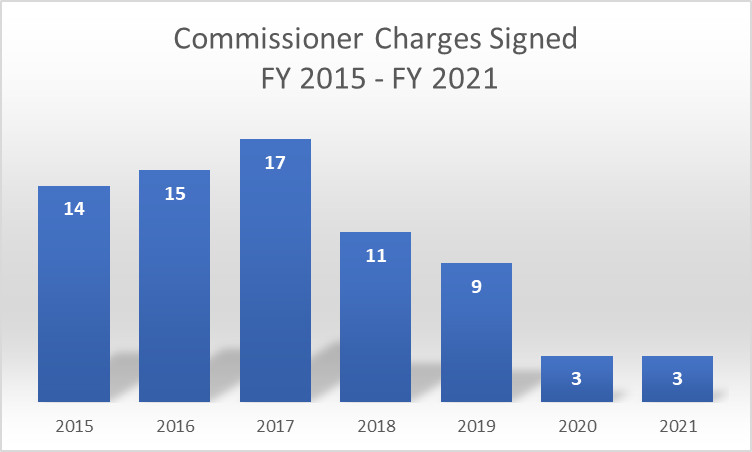
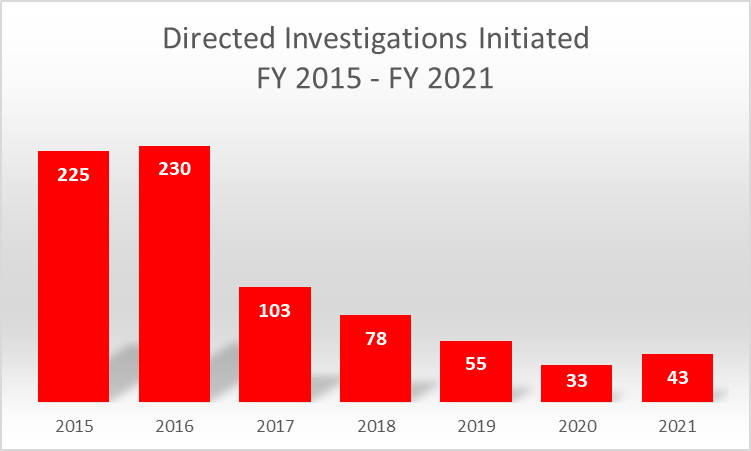
A10. From fiscal year 2015 through fiscal twelvemonth 2021, the EEOC initiated an average of 10 new Commissioner charges per twelvemonth addressing allegations under Championship 7, the ADA, and/or GINA, and an average of almost 110 new directed investigations per yr addressing allegations under the ADEA and/or the EPA. This represents a very small proportion – far less than 1% – of the Commission's almanac charge volume.
Q11. How often does a Commissioner'southward charge or a directed investigation result in an EEOC lawsuit?
A11. From financial year 2015 through fiscal twelvemonth 2019 the EEOC filed a total of 9 lawsuits based on a Commissioner'due south accuse or directed investigation, or an boilerplate of virtually two lawsuits per twelvemonth.
| Commissioner Charges Signed | |||
|---|---|---|---|
| FY 2020 | FY 2021 | ||
| Charlotte A. Burrows | 1 | Charlotte A. Burrows | 2 |
| Janet Dhillon | 1 | Jocelyn Samuels | one |
| Victoria A. Lipnic | 1 | Janet Dhillon | 0 |
| Total | 3 | Keith Due east. Sonderling | 0 |
| Andrea R. Lucas | 0 | ||
| Total | 3 | ||
[1] Every bit originally enacted, Title VII provided that Commissioners could file charges only when they had "reasonable cause to believe a violation of [Title Seven] has occurred." Pub. L. No. 88-352, § 706(a), 78 Stat. 241, 259 (1964). When Congress amended Title 7 in 1972, it eliminated that "reasonable crusade" requirement. EEOC five. Shell Oil Co., 466 U.S. 54, 62-63 (1984). The provision as amended in 1972 is all the same in effect today. 42 U.S.C. § 2000e-5(b). Thus, Commissioners are non obliged, before signing a Commissioner'south Accuse, to substantiate the allegations in the charge; rather, the purpose of the investigation is to decide if at that place is reasonable cause to believe that the charge allegations are true.See Shell Oil, 466 U.S. at 71-72 & n.26 (noting that "[n]othing in [Title VII] or its legislative history" supports the view that a courtroom must determine whether the charge is "well founded" before enforcing an EEOC subpoena in connexion with an EEOC investigation, including an investigation of a Commissioner charge).
[2] In the Committee's standard worksharing agreement with FEP agencies, those agencies have agreed in advance to waive any right to investigate Commissioner charges for up to 60 days before the EEOC begins its investigation.
[three] The EEOC's regulations qualify an exception to this dominion: the EEOC may continue processing a charge even afterward issuing a right to sue notice at an individual's asking, if whatever one of several enumerated EEOC officials determines that continuing the investigation would effectuate the statutory purposes of Championship VII, the ADA, or GINA. 29 C.F.R. § 1601.38(a)(3).
[iv] If the respondent is a state or local governmental entity and the EEOC's conciliation efforts are unsuccessful, any ensuing litigation may be conducted simply by the Department of Justice. 42 U.S.C. § 2000e-5(f)(1); 29 C.F.R. § 1601.27. Where the respondent is a authorities or governmental entity and the EEOC dismissed the accuse, the EEOC will consequence the notice of right to sue; otherwise, the Attorney General will issue the notice of right to sue. 29 C.F.R. § 1601.28(d).
[five] EEOC'south regulations also authorize it to investigate possible pay violations in the federal sector "on its own initiative" and "at any time." 29 C.F.R. § 1614.202(a) (EEOC authorized "to investigate an bureau'southward employment practices … in order to make up one's mind compliance with the provisions of the [Equal Pay] Act.").
[6] PCHP Section Three.C.3. states that "[d]irected investigations nether the ADEA and EPA volition be managed entirely at the field office, in accordance with the aforementioned principles applying to individually filed charges."
Source: https://www.eeoc.gov/commissioner-charges-and-directed-investigations
0 Response to "Which Governmental Entity Conducting an Employment Review Related to Alleged"
Postar um comentário